
Estimated read time: 8 minutes
You searched for an Allen-Bradley course on Udemy and landed here. That search is common among maintenance engineers in Peninsular Malaysia, Sabah, Sarawak and Singapore: the plant still runs a MicroLogix, the laptop has RSLogix 500, and the only learning path online is a recorded video with no PLC on the bench. This guide explains what RSLogix 500 and MicroLogix actually are, how they differ from RSLogix 5000, and how to choose between a video and a Hands-On class.
Why "Udemy Allen Bradley" keeps bringing engineers to a Malaysian training page
Recorded courses are easy to start. They are a weak match for the job you actually do on a Malaysian or Singaporean plant. A video can show you a ladder rung. It cannot hand you a faulted input card, a noisy analog signal, or an HMI screen that no longer talks to the processor. AS Automation Services built its Johor Bahru lab around that gap: 80% Hands-On and 20% theory, a maximum of 10 people in a class, and a PLC hardware kit on the bench for every trainee.
AS Automation Services and AS Automation Systems Training Centre PLT, Johor Bahru, have trained engineers since 2012: 13+ years, 301+ clients and 3,350+ engineers across 8 PLC brands. Allen-Bradley is taught with RSLogix 500 and RSLogix 5000, and the HMI is always in the same class.
What RSLogix 500 and MicroLogix actually are
RSLogix 500 is Rockwell Automation's programming software for the SLC 500 and MicroLogix families. If your panel was built in the 2000s for water treatment, F&B, a small packaging line or a port conveyor, there is a fair chance the processor is a MicroLogix 1100, 1200 or 1400, and the file on the maintenance laptop is an .RSS project, not an .ACD file.
MicroLogix is a compact processor: embedded I/O on the base, expansion I/O on the side, and a serial or Ethernet port depending on the model. Addressing is the classic SLC data table (B3, T4, C5, N7), not the tag database you meet later in Logix 5000.
The file you open tells you which course you need
Before you book anything, open the project your plant already uses. An .RSS file means RSLogix 500 and a MicroLogix or SLC processor. An .ACD file means RSLogix 5000 (or Studio 5000 Logix Designer) and a CompactLogix or ControlLogix processor. Mixing those up is the most common reason an engineer finishes a course and still cannot download to the machine on Monday.
RSLogix 500 vs RSLogix 5000: pick the family your plant uses
Both are Allen-Bradley. They are not interchangeable, and a video titled "Allen-Bradley PLC" often teaches only one of them.
- RSLogix 500 / MicroLogix / SLC 500. Data files, fixed addresses such as I:0/0 and O:0/1, RSLinx Classic for the driver, and a smaller instruction set. Common on older lines that still run well and will not be replaced this year.
- RSLogix 5000 / CompactLogix / ControlLogix. Named tags, tasks and programs, Add-On Instructions on larger jobs, and Ethernet/IP as the default network. This is what most new panels in oil and gas, pharma and electronics plants specify today.
- Connected Components Workbench (CCW). A different, free-to-start environment aimed at Micro800. If your quote says Micro850, you are not in RSLogix 500. AS Automation Services covers that path on a separate MicroLogix / CCW class so the two software packages are not blurred together.
If your site has both families, do the one that fails most often first. A 3-day class on the wrong software is a wasted HRDCorp claim.
What a self-paced video cannot rehearse
A recorded Allen-Bradley course is useful for vocabulary. It is a poor substitute for the five things that actually stop a line:
- Going online without changing the program. You need to see the difference between a download and an upload before you touch a live processor. A pause button does not teach that habit.
- RSLinx driver faults. The DF1, Ethernet/IP or USB driver that will not browse is half of all first-week callouts. You only learn it by breaking the cable and putting it back.
- Data-file addressing mistakes. Writing to the wrong N7 word, or using a timer accumulator as if it were a preset, is a classic MicroLogix error. You spot it faster when the output lamp in front of you does not come on.
- HMI tag mapping. The panel view or third-party HMI that "lost comms" is usually an address mismatch, not a dead PLC. Our classes wire the HMI in the same exercise, because that is how the panel was built.
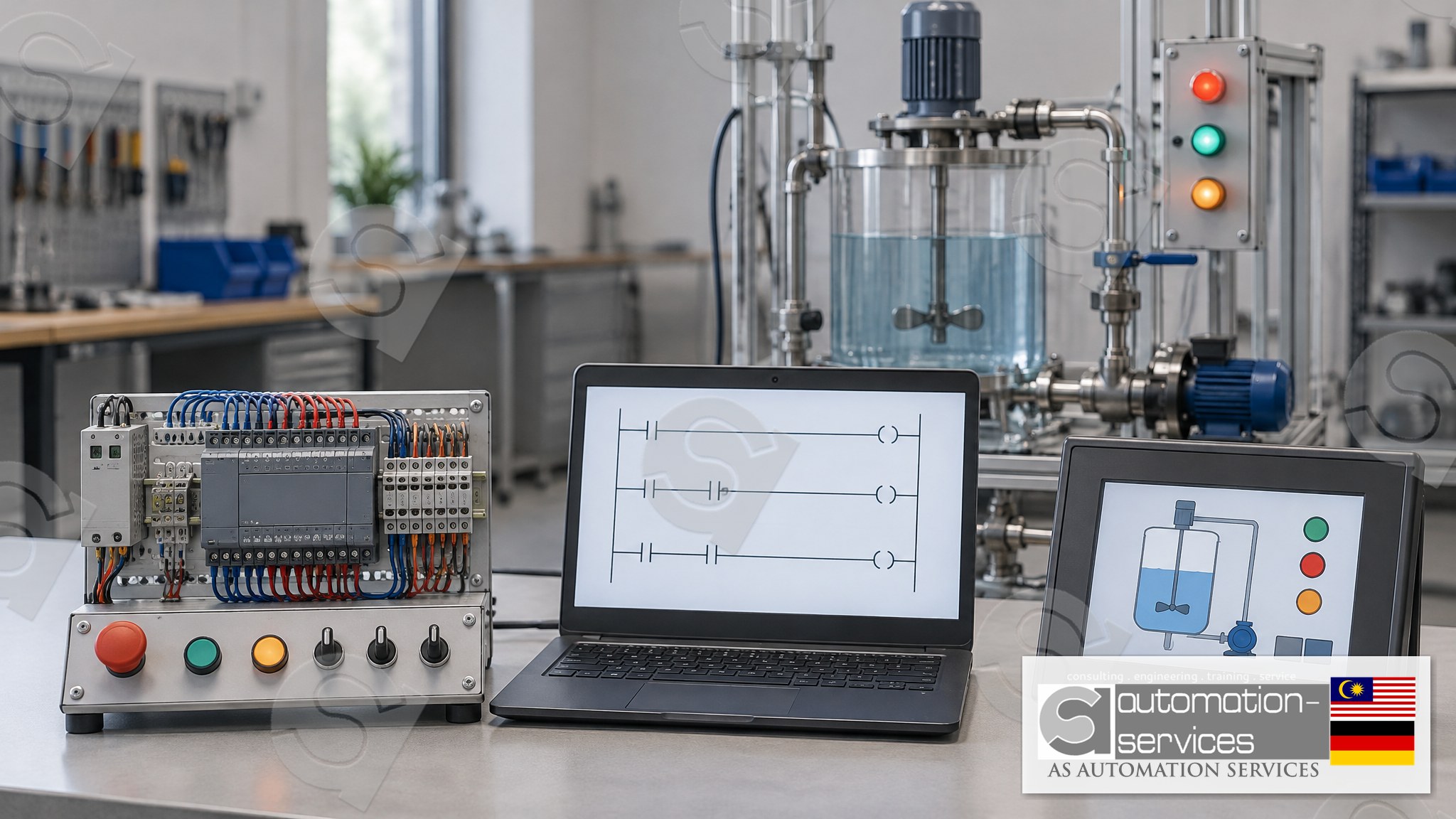
- A small project you can defend. Our standard project is the Mixer Tank: start, stop, level, interlock, alarm and a simple HMI. You leave with a program you wrote, not a screenshot of someone else's.
Each trainee gets a manual, a laptop, a PLC hardware kit, a certificate and free lifetime support. That last item matters when the night shift calls you six months later.
How the Johor Bahru Allen-Bradley class is structured
Two formats cover this brand. The 3-day class is Basic to Intermediate: PLC plus HMI, aimed at MicroLogix with RSLogix 500, and at the separate Micro800 / CCW path if that is what your panel uses. The 5-day class is Basic to Advanced on RSLogix 5000 with CompactLogix and ControlLogix, and it adds analog I/O, VFD, IIoT and webserver topics, plus SCADA. HMI and SCADA are bundled with the PLC. We do not run them as standalone courses, and we do not teach AVEVA or Wonderware.
Class size is capped at 10. Five or more people can train onsite anywhere in Peninsular Malaysia, Sabah, Sarawak or Singapore. Fewer than 5 train at the Johor Bahru lab, where the hardware is already wired.
Malaysian companies can claim the course under HRDCorp SBL-Khas. The claim applies to Malaysian companies only, with a minimum of 2 participants. Both company-sponsored groups and personal enrolment are accepted. HR and training managers usually ask for the provider status up front: AS Automation Services is an HRDCorp Registered Training Provider, and the centre is also ISA, GAMP, MATA and D-U-N-S registered.
You can read the course outlines here: Allen-Bradley RSLogix 500, 3 days and Allen-Bradley RSLogix 5000, 5 days. The Micro800 / CCW outline sits at MicroLogix and CCW, 3 days.
A safe way to practise addressing before you book
This section is educational. It is not a procedure for a live processor. Do not download, force, or change a program on running equipment. Work only on a training kit, a spare processor, or a simulator, with a colleague watching, and with the machine isolated under your site's permit-to-work rules.
On a training MicroLogix, open the data files before you write a rung. I:0 is inputs, O:0 is outputs, B3 is bits, T4 is timers, C5 is counters, N7 is integers. A TON has three bits: EN, TT and DN. The preset is in 0.01-second units, so 100 is one second, not 100 seconds. That unit mistake is behind a lot of "the timer is too fast" complaints.
Write one rung: a start pushbutton seals a run bit, a stop pushbutton breaks the seal, and the run bit enables a TON. When the timer is done, turn on one lamp. Then force nothing. Go online in read mode only, toggle the input on the training kit, and watch EN, TT and DN change. If you can explain that rung to a colleague without looking at the screen, you are ready for a class. If you cannot, a 40-hour video will not fix it faster than one afternoon on a kit.
For a longer walk-through of how a multi-day class feels from the trainee side, read this SLC 500 Hands-On class write-up. It is a training highlight, not a software manual, and it shows the same 80/20 split you would get in Johor Bahru.
Who this is for, and who should pick a different brand first
Book the RSLogix 500 path if you maintain MicroLogix or SLC 500 panels and your project files are .RSS. Book the RSLogix 5000 path if your site is CompactLogix or ControlLogix. Fresh graduates who have never seen either family should start with the brand their first employer actually uses. If that employer has not been named yet, Siemens S7-1200 and Mitsubishi FX5U are the other two families we see most often on new Malaysian lines, and each has its own course.
The class is for maintenance and electrical engineers, automation technicians, fresh graduates, project engineers, individual upskillers, factory owners and HR managers. Industries include pharma, oil and gas, electronics, construction, ports, shipyards, F&B, entertainment, universities and automation servicing companies, across Peninsular Malaysia, Sabah, Sarawak and Singapore only.
FAQ
Is an Udemy Allen-Bradley course enough to program a MicroLogix at work?
A recorded course can teach menu names and the look of a ladder rung. It will not give you a processor, a driver fault or an HMI to repair. If your plant runs MicroLogix, pair any video with time on real hardware. A 3-day Hands-On class in Johor Bahru covers that gap, with a kit and a certificate included.
What is the difference between RSLogix 500 and RSLogix 5000?
RSLogix 500 programs SLC 500 and MicroLogix using data files and fixed addresses, and the project is an .RSS file. RSLogix 5000 programs CompactLogix and ControlLogix using named tags, and the project is an .ACD file. They are not the same software. Open your plant's project file before you choose a course, or you will learn the wrong family.
Can my company claim Allen-Bradley training under HRDCorp?
Yes, for Malaysian companies, under SBL-Khas, with a minimum of 2 participants. Personal enrolment is also accepted if you are paying for yourself. The claim does not apply to companies outside Malaysia. AS Automation Services is an HRDCorp Registered Training Provider, and the class can run onsite when you send 5 or more people.
Do you teach Micro800 and Connected Components Workbench in the same class?
No. CCW and Micro800 are a different path from RSLogix 500. Mixing them in one short class leaves both half-learned. Ask for the CCW outline if your panel is a Micro850, and the RSLogix 500 outline if your file is .RSS. Tell us the processor model when you enquire.
Next step
Bring your processor model and a screenshot of the project file extension. We will tell you whether you need RSLogix 500, RSLogix 5000 or CCW before you book a seat.
- Courses: https://asasmy.com/training
- Troubleshooting: https://asasmy.com/service-inquiry?service=troubleshooting
- HRDCorp SBL-Khas claimable training for Malaysian companies (minimum 2 participants; company-sponsored and personal enrolment)
- PLCPro Academy: https://asasmy.com/services/plcpro-academy
- Request a quotation: https://asasmy.com/rfq
- WhatsApp: +60 10-244 3914 (Mr. Yokes)
- Email: [email protected]
Interested in Hands-On PLC Training?
HRDCorp claimable courses on real industrial equipment — at our Johor Bahru lab or onsite at your factory anywhere in Malaysia.
Request Training Quotation