Estimated read time: 8 minutes
If you searched for an automation training course and landed on four different pages, you are not the only one. Maintenance engineers, training managers and fresh graduates in Peninsular Malaysia, Sabah, Sarawak and Singapore all ask the same practical question: do you need three days or five, and do you come to the Johor Bahru lab or bring the class to the plant? This guide answers that before you send an enquiry, so you pick a format that matches the fault you actually face on shift.
What an Automation Training Course Covers Here
AS Automation Services and AS Automation Systems Training Centre PLT have run Hands-On PLC training from Johor Bahru since 2012. The centre is an HRDCorp Registered Training Provider, and it is also ISA, GAMP, MATA and D-U-N-S registered. Across 13-plus years the lab has trained 3,350-plus engineers from 301-plus clients, on eight PLC brands.
Every course is a PLC course first. HMI practice is bundled with the PLC, and SCADA practice appears only on the five-day format, also bundled with the PLC. There is no standalone HMI course and no standalone SCADA course. There is also no DCS course. If your plant runs a DCS, this training still helps your engineers read the PLC layer that sits beside it, but it will not teach DCS configuration.
The standard project on every course is the Mixer Tank. You wire, download and test a real sequence on a training kit, not on a live production line. A safety note sits further down, because nothing in this guide is an instruction for equipment that is running.
The 3-Day Format: Basic to Intermediate
The three-day course is Basic to Intermediate. It covers the PLC and the bundled HMI. You work through addressing, ladder logic, timers, counters, a simple sequence and an HMI screen that talks to that sequence. It suits an engineer who already walks the line and needs a structured start on one brand, or a fresh graduate who has theory but has never downloaded a program to hardware.
Three days is enough when the goal is confidence: you can open the software, read a rung, force a bit safely on a training kit and explain what the HMI is showing. It is not enough if your brief includes analog loops, a variable frequency drive or a web page served by the PLC. Those sit in the five-day format.
Three-day options exist across the brands the lab teaches, including Siemens TIA Portal, Mitsubishi GX Works3, Omron CX-Programmer and Sysmac Studio, Allen-Bradley RSLogix 500, Keyence KV Studio and Schneider Machine Expert. Pick the brand that matches the cabinet you open on Monday morning.
The 5-Day Format: Basic to Advanced
The five-day course is Basic to Advanced. It keeps the PLC and HMI work from the shorter format, then adds analog input and analog output, a variable frequency drive, IIoT and webserver topics, and SCADA bundled with the PLC. You still build the Mixer Tank, but you extend it: a level or temperature signal, a drive start from the PLC, and a screen or web page you can show a supervisor.
Choose five days when the plant fault is not a simple digital sequence. A pump that hunts, a drive that trips on a speed reference, or a request to view a tag from the office all need the longer format. Training managers booking under HRDCorp SBL-Khas usually find five days easier to justify, because the outcome list is wider and the same two-person minimum still applies.
Five-day courses are available for Siemens S7-1200 and S7-1500 on TIA Portal V18 with WinCC Comfort, Siemens S7-300 and S7-400 on Simatic Manager with WinCC Flexible, Mitsubishi FX5U on GX Works3 with a Weintek HMI, Omron NX on Sysmac Studio with an NB HMI, Allen-Bradley on RSLogix 5000, Keyence on KV Studio with VT Studio, and Schneider TM221 on Machine Expert with Vijeo Designer.
Johor Bahru Lab or Onsite at Your Plant
Class size is capped at 10. That cap is the same in the lab and onsite, so a large department is split into more than one session rather than squeezed into one room. Below five participants, the class runs at the Johor Bahru lab. From five participants upward, onsite training is available at your plant in Peninsular Malaysia, Sabah, Sarawak or Singapore.
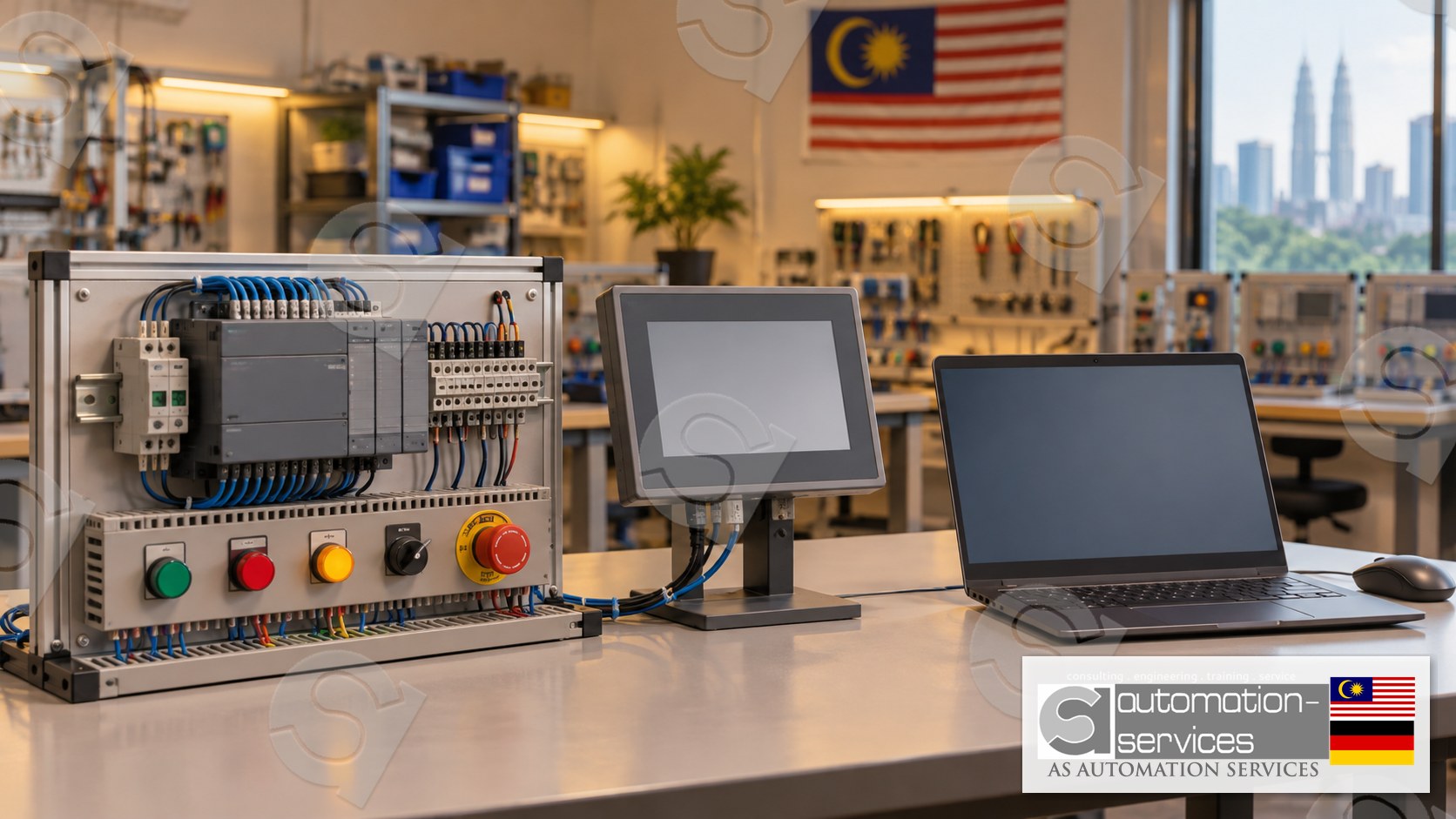
The lab suits mixed groups: two engineers from your site plus others from different plants, or a personal enrolment. You use the centre's PLC hardware kit and a laptop that is set up before you arrive. Onsite suits a team that must learn the brand already installed in their own panels, with the same Mixer Tank method and the same software, brought to you.
Neither option is a repair visit. The trainer does not open your live cabinet to fix a failed module. If a machine is down, use the troubleshooting enquiry and keep the training booking for the skill your team will need on the next fault. Mixing the two wastes the class and risks the line.
Who the Course Is For
The room is built for maintenance and electrical engineers, automation technicians, fresh graduates, project engineers and individual upskillers. HR and training managers, and factory owners, usually book the seats rather than sit in them. Participants come from pharma, oil and gas, electronics, construction, ports, shipyards, food and beverage, entertainment, universities and automation servicing companies.
You do not need a programming background. You do need to be comfortable around a panel: knowing what a contactor and a sensor are is enough to start the three-day course. If you already write ladder for one brand and want a second, say so in the enquiry so the trainer does not repeat your first week of basics.
What Is Included, and What Is Not
Each seat includes a manual, a laptop, a PLC hardware kit, a certificate and free lifetime support. Support means you can ask about what you practised, after the class, for as long as you need. It does not mean the centre will program your production line or repair a module.
Malaysian companies can claim the course under HRDCorp SBL-Khas. The claim needs a minimum of two participants, and it is open to company-sponsored seats and to personal enrolment. Singapore teams book the same formats; the HRDCorp claim itself applies to Malaysian companies only.
If your company wants a private room with no other firms present, ask about PLCPro Academy when you send the enquiry. It uses the same brands, the same Hands-On ratio and the same formats, arranged for one organisation.
How to Choose in Ten Minutes
Write down the brand on the cabinet, the software name on the engineering laptop, and the fault you most want to stop repeating. If that fault is a digital sequence or an HMI that nobody can edit, book three days on that brand. If it involves an analog signal, a drive, a webserver or a SCADA screen, book five days. Count your participants: under five means the Johor Bahru lab, five or more means you may request onsite.
Then send an RFQ or a WhatsApp message with those three facts. You will get a date and a format, not a guess. Do not book a brand because a colleague liked it. Book the brand your plant already owns, unless you are a fresh graduate choosing a first platform, in which case the Siemens or Mitsubishi three-day course is a solid start in this region.
Safety Note
Everything described here happens on a training kit, with the panel isolated and the trainer present. Do not use this article as a procedure for a live machine. Forcing a bit, downloading a program or changing a drive parameter on running equipment can start a motor, open a valve or drop a load. If you are not authorised and not competent for that panel, leave it alone and call the person who is. Training builds that competence. It does not replace your plant's permit and lockout rules.
Frequently Asked Questions
Is a 3-day automation training course enough?
Yes, if your goal is Basic to Intermediate PLC and bundled HMI on one brand. You leave able to read ladder, download to a training kit and build a simple HMI screen. Analog signals, drives, webserver and SCADA need the five-day Basic to Advanced format instead.
Can the course run onsite at our factory?
Yes, when you book five or more participants, up to the class cap of 10. Smaller groups train at the Johor Bahru lab, where the hardware kit and laptop are ready. Onsite covers Peninsular Malaysia, Sabah, Sarawak and Singapore, using the same Mixer Tank project.
Is the automation training course HRDCorp claimable?
Malaysian companies can claim it under HRDCorp SBL-Khas, with a minimum of two participants. Company-sponsored seats and personal enrolment both qualify for the claim. The claim does not apply to Singapore companies, who book the same three-day and five-day formats directly with the centre.
Do you teach HMI or SCADA on their own?
No. HMI is taught only inside a PLC course, on both the three-day and five-day formats. SCADA is taught only inside the five-day PLC course. There is no standalone HMI course, no standalone SCADA course and no DCS course at this centre.
Ready to pick a date? Browse the course list, compare it with the guide to which PLC brand to learn first, or send an RFQ. A machine that is down now goes to troubleshooting, not into a training seat. Malaysian companies should ask about HRDCorp SBL-Khas claimable training, which needs a minimum of two participants and covers company-sponsored and personal enrolment. One organisation wanting its own room can ask about PLCPro Academy. WhatsApp Mr. Yokes on +60 10-244 3914 or email [email protected].
Interested in Hands-On PLC Training?
HRDCorp claimable courses on real industrial equipment — at our Johor Bahru lab or onsite at your factory anywhere in Malaysia.
Request Training Quotation