Estimated read time: 8 minutes
If you searched for PLC repair in Malaysia, you are probably standing in front of a stopped line, or you are planning so that moment never happens. Either way, the question behind the search is the same: do you need someone to fix the controller, or do you need your own people to understand it? This guide explains what PLC repair actually covers, where it ends, and where Hands-On PLC training takes over, for engineers and managers in Peninsular Malaysia, Sabah, Sarawak and Singapore.
What PLC repair usually means
When a plant asks for PLC repair, it is almost never asking for one single thing. The words cover three very different jobs, and mixing them up is how repair requests get sent to the wrong person.
Component-level repair
This is the workshop job. A power supply, an output card or a CPU module has failed, and someone tests the board, replaces failed components and returns it. It needs electronics bench skills, test equipment and parts stock. It does not need ladder logic knowledge, and it does not teach your team anything about the program running the machine.
System-level fault finding
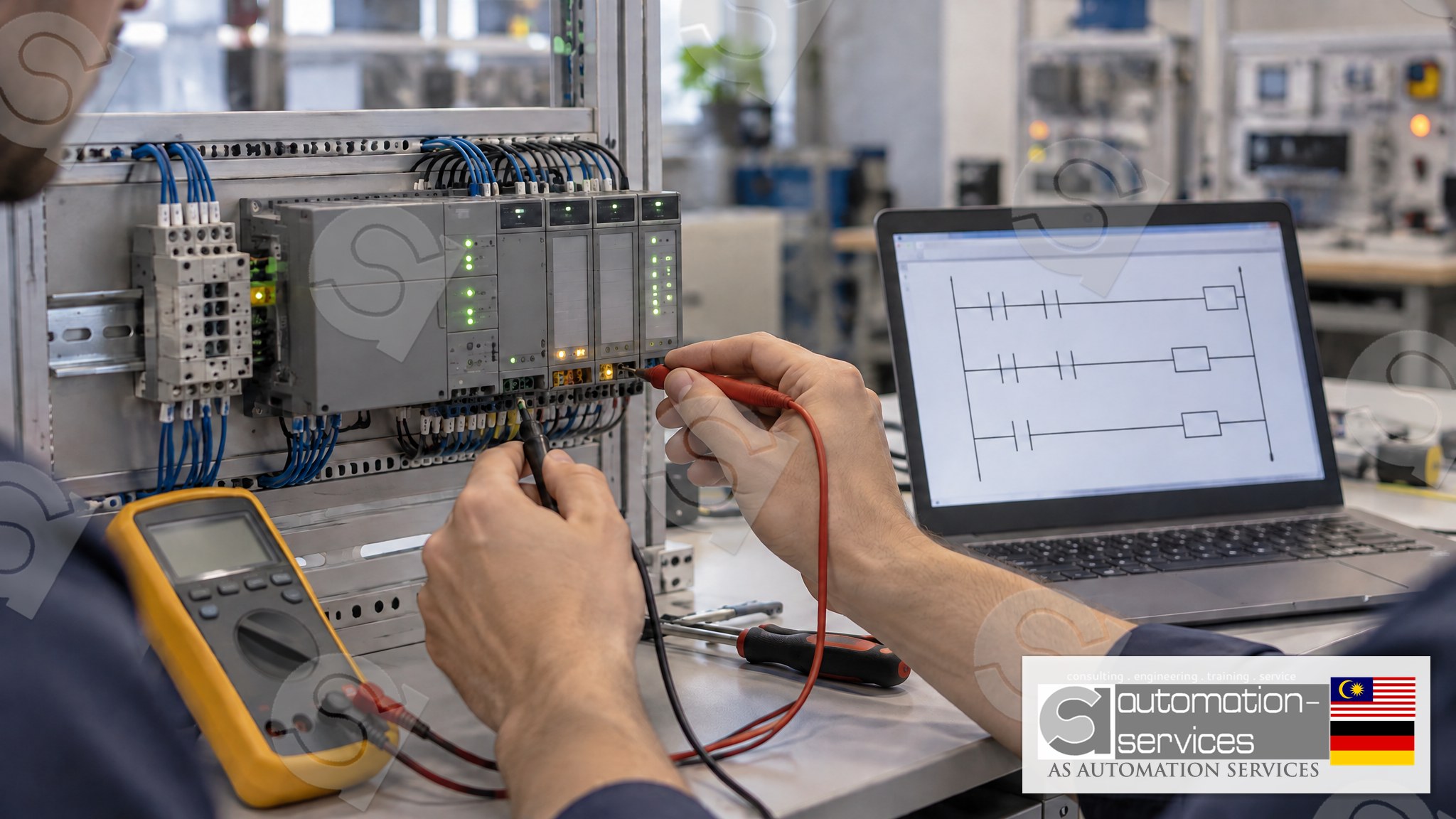
This is the plant-floor job. The machine has stopped, the controller is still powered, and nobody knows whether the fault is in the program, the wiring, a sensor, a drive or the module itself. This job needs someone who can go online with the software, read the logic and trace a signal from the field device back to the instruction that uses it. That is an engineering skill, not a workshop skill.
Repair as a stopgap
Sometimes the real problem is that only one person in the factory understands the program, and that person is on leave. A repair contractor can get the line moving again today. The same fault will cost you the same call-out next month unless someone on your payroll can read the logic.
Where training is the better spend
PLC training does not replace a repair workshop, and a repair workshop does not replace training. The two solve different problems, and most plants in Malaysia and Singapore need both at different times.
- You need repair when a module is physically damaged and you have no spare. No amount of training resolders a burnt output transistor.
- You need training when faults repeat, when diagnosis takes hours, or when the only person who can go online with the PLC is about to retire or resign.
- You need both when a new line arrives with a brand your team has never programmed. The commissioning contractor leaves, and the first fault is yours.
The pattern we see most often is a maintenance team that can swap a module but cannot prove the module was the problem. They replace the card, the fault stays, and the line stays down while a second card is ordered. The missing skill is not electronics. It is reading the program and the diagnostics the controller already provides.
What a trained engineer can diagnose alone
A technician who has only learned by watching can check power, check fuses and swap a suspect card. A technician who has worked through a structured course can do considerably more before calling anyone.
- Go online with the correct software and confirm the CPU state, the fault buffer and the module status.
- Tell a program fault from a hardware fault, and a sensor fault from a wiring fault.
- Force and monitor signals safely on a training kit first, so the same steps are calm and deliberate on the real machine later.
- Back up the program before anyone changes it, which is the step most often skipped during a breakdown.
- Document what was found, so the next shift does not start the diagnosis from zero.
None of this removes the need for a repair workshop when a board is genuinely dead. It removes the calls where the board was fine and the fault was a loose wire, a wrong parameter or a condition the program was waiting for.
The brands your plant is likely running
Repair knowledge is brand-specific, because the software, the cable and the diagnostics are brand-specific. A technician fluent in one platform can be lost on the next, even with years of experience. The brands we train on, and the software each uses, are:
- Siemens S7-1200 and S7-1500 with TIA Portal, and S7-300 and S7-400 with Simatic Manager.
- Mitsubishi FX5U with GX Works3.
- Omron CP1E and CP1L with CX-Programmer, and the NX series with Sysmac Studio.
- Allen-Bradley MicroLogix with RSLogix 500, and CompactLogix and ControlLogix with RSLogix 5000.
- Keyence with KV Studio, and Schneider TM221 with Machine Expert.
If your breakdowns cluster on one of these, that is the course to book first. Learning a second brand is much faster once the first one is solid, because scan cycles, I/O addressing and fault buffers work on the same ideas everywhere.
What the training covers
Courses run in two lengths. The 3-day format takes you from basic to intermediate and covers the PLC together with its HMI. The 5-day format continues to advanced level and adds analog inputs and outputs, a variable frequency drive, an IIoT and webserver exercise, and SCADA. HMI and SCADA are taught inside the PLC course, not as separate classes.
About 80 percent of the time is Hands-On on a real PLC hardware kit, with the rest on the theory that makes the exercises make sense. The standard project is a Mixer Tank, so every exercise ends with something you can see working. Each class is capped at 10 participants. Classes of 5 or more can be run at your site; smaller classes run at the Johor Bahru lab. Every participant gets a manual, a laptop, the PLC hardware kit, a certificate and free lifetime support afterwards.
For Malaysian companies, the training is HRDCorp SBL-Khas claimable, with a minimum of 2 participants, and it can be company-sponsored or a personal enrolment. Participants from Singapore join as personal enrolments.
A sensible order of operations
If a line is down right now, repair comes first. Get the module tested or replaced, get the program backed up, and write down exactly what failed. Then book the training while the incident is still fresh, because that is when your team will actually pay attention.
If the line is running, start with the brand that causes the most lost hours, not the brand that sounds most impressive. One engineer who can diagnose your most common controller is worth more than a team that has watched videos of all eight.
Safety note: everything described here is taught and practised on training kits in a classroom or at your training setup, never as instructions for working on live plant equipment. Fault finding on a running machine belongs to people authorised and competent for that plant, following its permit and lockout procedures. Do not force outputs, bridge terminals or open panels on live equipment based on a blog post.
Frequently asked questions
Can PLC training replace sending a faulty module for repair?
No. Training teaches your team to diagnose faults and to prove whether a module is actually the cause. A physically damaged card still needs a workshop with parts and test equipment. The two are complementary, and most plants end up using both.
Which course should we book after a breakdown?
Book the brand and software that actually failed. If the fault was on an S7-1200, book the Siemens TIA Portal course, not a general introduction. The 3-day course covers PLC and HMI; the 5-day course adds analog, VFD, IIoT and SCADA.
Do you repair PLC modules at the Johor Bahru lab?
No. The lab is a training facility with PLC hardware kits, not a component repair workshop. If your module is physically damaged, send it to a repair workshop. If your team cannot diagnose why it failed, that is what the courses are for.
Is the training claimable, and who can join?
Malaysian companies can claim through HRDCorp SBL-Khas with a minimum of 2 participants, whether the company sponsors them or they enrol personally. Engineers from Singapore, Sabah and Sarawak are welcome, classes are capped at 10, and every participant gets a certificate.
Next step
If your team loses hours every month tracing faults on a controller nobody fully understands, training is the fix that compounds. Repair gets today's line running. A technician who can read the program gets the next ten faults solved in-house.
Courses: https://asasmy.com/training
Troubleshooting enquiries: https://asasmy.com/service-inquiry?service=troubleshooting
HRDCorp SBL-Khas claimable training for Malaysian companies (minimum 2 participants; company-sponsored or personal enrolment)
PLCPro Academy: https://asasmy.com/services/plcpro-academy
Request a quotation: https://asasmy.com/rfq
WhatsApp: +60 10-244 3914 (Mr. Yokes)
Email: [email protected]
Related reading: PLC fault diagnosis on a Siemens S7-1200 and the Siemens S7-1200 TIA Portal course.
Interested in Hands-On PLC Training?
HRDCorp claimable courses on real industrial equipment — at our Johor Bahru lab or onsite at your factory anywhere in Malaysia.
Request Training Quotation