
Estimated read time: 8 minutes
If you searched for stepper motors because a positioning axis on your machine keeps losing steps, you are in the right place. A stepper motor is one of the first motion devices a maintenance engineer meets, and it is also one of the easiest to misread. This guide explains what a stepper motor is, the types you will actually see on plant equipment in Peninsular Malaysia, Sabah, Sarawak and Singapore, how a PLC drives one, and what you practise on a training kit before you touch a live axis.
What a Stepper Motor Actually Does
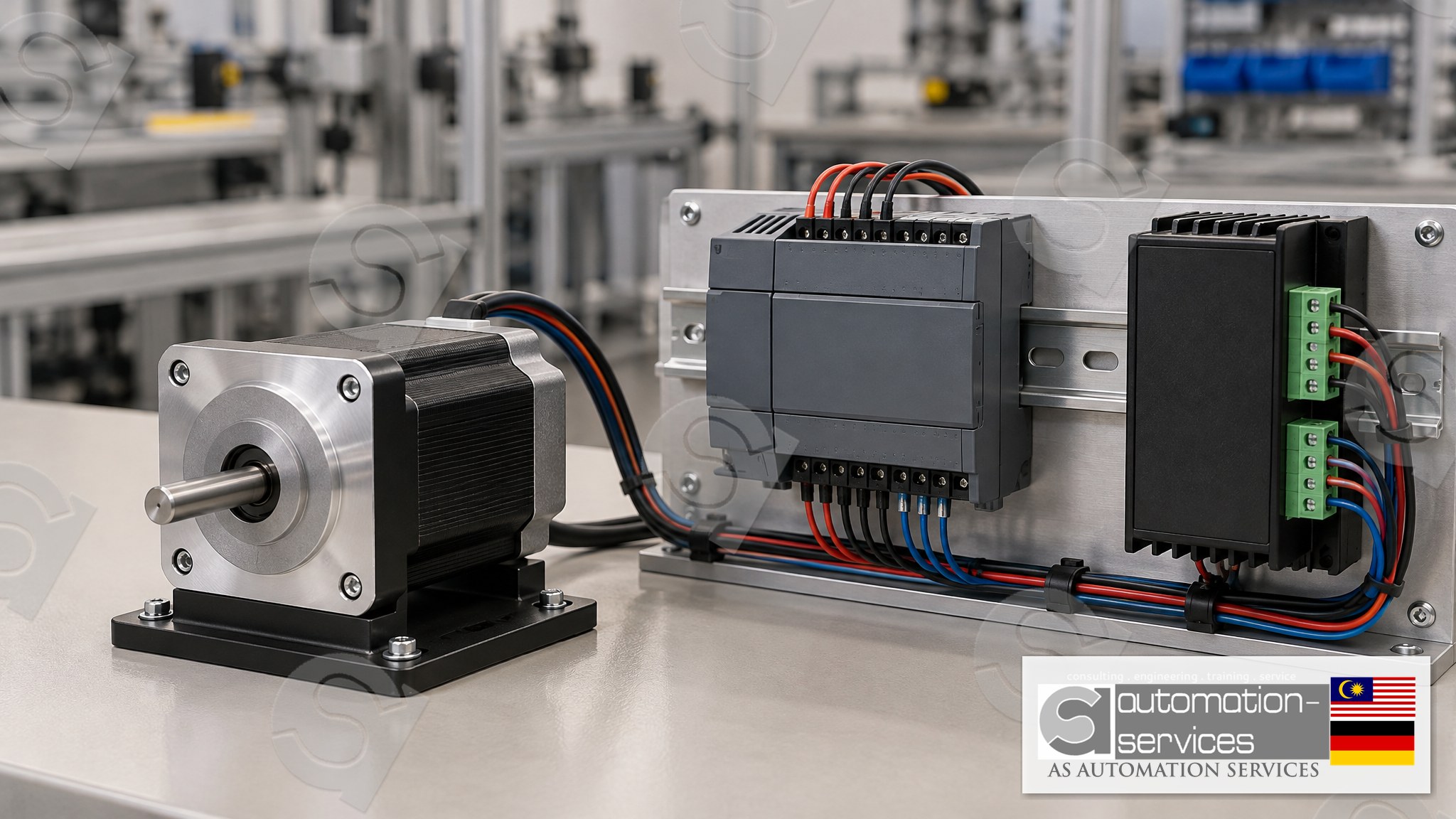
A stepper motor turns in fixed angular steps instead of spinning freely like an ordinary induction motor. Each pulse from the controller moves the shaft one step, so position comes from counting pulses rather than from a feedback encoder. That is why packaging machines, labelling heads, small pick-and-place units and indexing tables use them: the motion is predictable, and the wiring is simpler than a servo.
The trade-off is real. If the load is heavier than the torque available at that speed, the motor skips steps and the controller never knows, because it is counting pulses it sent, not movement it measured. Understanding that one sentence saves you hours of chasing a "PLC fault" that is really a mechanical or sizing problem.
Types of Stepper Motor You Will Meet on Site
You do not need a catalogue. Three families cover almost everything you will open up on a machine in Johor, Penang, Selangor or Singapore.
Permanent magnet steppers
A permanent magnet rotor, low step count, modest torque. You find these in small feeders, ticket dispensers and light positioning jobs. They are cheap and they hold position when powered, but they are not the motor behind a serious indexing table.
Variable reluctance steppers
A soft-iron rotor with no magnet, pulled toward energised stator teeth. They step quickly but hold poorly when unpowered, so you rarely see them on production equipment today. Knowing the name matters mainly so you can recognise an old drawing.
Hybrid steppers
This is the one on your machine. A hybrid stepper combines a toothed rotor with a permanent magnet, giving fine steps — commonly 1.8 degrees, or 200 steps per revolution — and usable holding torque. Nearly every industrial stepper in packaging and electronics assembly is a hybrid, driven by a separate stepper drive rather than directly from PLC outputs.
The Drive Modes Behind the Pulses
The stepper drive, not the PLC, decides how the windings are energised. Three modes are worth knowing before you sit in front of a training kit.
- Full step. One pulse, one full step. Maximum torque, coarsest resolution. Fine for simple indexing where position tolerance is loose.
- Half step. The drive alternates between one and two windings energised, doubling the resolution and smoothing the motion. A common default on older machines.
- Microstepping. The drive splits each full step into many smaller ones, often 8, 10 or more. Motion looks continuous and resonance drops, but torque per microstep falls and the extra resolution is not the same thing as accuracy. If your drawing says 1,600 pulses per revolution, someone has set 8x microstepping on a 200-step motor.
There is a safety point here, and it applies to everything below. This is training-kit context, not an instruction for a running machine. Never rewire a stepper drive, change dip switches or force outputs on live equipment. Isolation, lockout and your site's permit-to-work come first, and motion axes can move without warning.
How a PLC Drives a Stepper
On almost every machine you will commission, the PLC does not power the motor. It sends two signals to a stepper drive: a pulse train, where each pulse means one step, and a direction bit. The drive handles current, winding sequence and microstepping. Your job as the programmer is to generate the right number of pulses at the right rate.
That is exactly what the motion section of a PLC course is for. In a 5-day Basic-to-Advanced class at AS Automation Systems Training Centre PLT in Johor Bahru, you build this on the standard Mixer Tank project using the brand's own hardware and software — Siemens S7-1200 with TIA Portal, Mitsubishi FX5U with GX Works3, Omron NX with Sysmac Studio, Allen-Bradley CompactLogix with RSLogix 5000, Keyence KV Studio or Schneider TM221 with Machine Expert. The 3-day Basic-to-Intermediate class covers PLC plus bundled HMI; pulse output and positioning sit in the longer format, alongside analog I/O, VFD work and the bundled SCADA module. HMI and SCADA are only ever taught inside a PLC course, never on their own.
What you practise is the logic, not a live production axis: configure a high-speed output, ramp the frequency up and down so the motor does not stall on the first pulse, count the pulses against a target position, and show the position on the HMI that ships with the course. The class is 80% Hands-On and 20% theory, capped at 10 trainees, with a manual, a laptop, a PLC hardware kit, a certificate and free lifetime support included.
Stepper or Servo: the Question Your Manager Will Ask
You will be asked this, so have a clean answer. A stepper is open loop: simple wiring, no encoder to fail, good for light-to-moderate loads at moderate speed, and it holds position when energised. A servo is closed loop: it costs more, it needs tuning, and it tells you when it cannot reach the position. When the load varies, the speed is high or a missed step would scrap product, a servo earns its place. When the axis is a simple index or a feeder, a stepper is usually the right call. Neither answer is universal, which is why it belongs in a Hands-On session where you can feel the difference rather than in a one-line rule.
Why Your Axis Loses Steps
When an axis drifts, people blame the program first. Work through the physics before you open the editor.
- Acceleration too sharp. A stepper needs a ramp. Demanding full speed on the first pulse stalls it immediately, and every pulse after that is a lost step.
- Speed above the torque curve. Available torque falls as speed rises. A motor that indexes perfectly slowly will skip when the line speeds up.
- Resonance. At certain step rates the motor vibrates and loses lock. Microstepping and a change of acceleration usually cure it.
- Mechanical load. A tight guide, a dry bearing or a heavier product than the axis was sized for shows up as lost steps, not as a PLC alarm.
- Wiring and supply. A shared supply that sags, or a pulse signal run beside a VFD cable, corrupts the count. The program is innocent.
Notice what is missing: a fault code. Open-loop steppers fail quietly. The only symptom is a position that is wrong, which is why checking the pulse count against the mechanical position is the first measurement, not the last.
What to Learn, and Where
If stepper-driven axes are part of your plant, the useful skill is not memorising motor types. It is generating and counting pulses confidently, then reading the result on an HMI. That is covered in the 5-day classes, for example the Mitsubishi FX5U GX Works3 advanced course, and the same motion topics run across the Siemens, Omron, Allen-Bradley, Keyence and Schneider advanced classes listed on the training page.
Classes run at the Johor Bahru lab, and onsite from 5 trainees; groups under 5 train at the lab. Malaysian companies can claim the training through HRDCorp under SBL-Khas, with a minimum of 2 trainees, whether the company sponsors the seat or you enrol personally. Onsite training is available across Peninsular Malaysia, Sabah and Sarawak, and trainees from Singapore are welcome at the Johor Bahru lab. If you want the wider picture of how a plant's PLC choices fit together, the guide to choosing your first PLC brand is a good companion to this one.
Frequently Asked Questions
What is a stepper motor used for with a PLC?
A PLC uses a stepper motor for simple, repeatable positioning: indexing a table, feeding a label or moving a small pick-and-place head. The PLC sends pulses and a direction signal to a drive, and each pulse moves the shaft one step. You practise exactly this pulse-and-count logic on a training kit during a PLC course, never on a live axis.
What is the difference between full step and microstepping?
Full step moves the motor one complete step per pulse, giving the most torque and the coarsest resolution. Microstepping splits each step into many smaller ones, so the motion is smoother and resonance drops, but torque per microstep is lower. Smoother is not the same as more accurate, so check what the axis actually needs.
Why does a stepper motor lose steps?
Usually the load exceeds the torque available at that speed, the acceleration ramp is too steep, or the motor is running near a resonant speed. Because a stepper is open loop, the controller counts pulses sent, not movement achieved, so it raises no alarm. Check the mechanics and the pulse rate before editing the program.
Do I need a servo instead of a stepper?
Use a stepper for light-to-moderate loads at moderate speed where a missed step is tolerable and easy to detect. Choose a servo when the load varies, the speed is high or a wrong position would scrap product, because a servo reports when it falls short. The right choice depends on the axis, not on the brand.
Ready to Practise This on Real Hardware?
Reading about pulse trains is not the same as wiring one and watching the count land on target. Come and do it on a training kit, with the manual, laptop, PLC hardware and certificate included, plus free lifetime support afterwards.
- Courses: https://asasmy.com/training
- Troubleshooting: https://asasmy.com/service-inquiry?service=troubleshooting
- HRDCorp SBL-Khas claimable training — Malaysian companies only, minimum 2 trainees, company-sponsored or personal enrolment
- PLCPro Academy: https://asasmy.com/services/plcpro-academy
- Request a quotation: https://asasmy.com/rfq
- WhatsApp: +60 10-244 3914 (Mr. Yokes)
- Email: [email protected]
Interested in Hands-On PLC Training?
HRDCorp claimable courses on real industrial equipment — at our Johor Bahru lab or onsite at your factory anywhere in Malaysia.
Request Training Quotation